

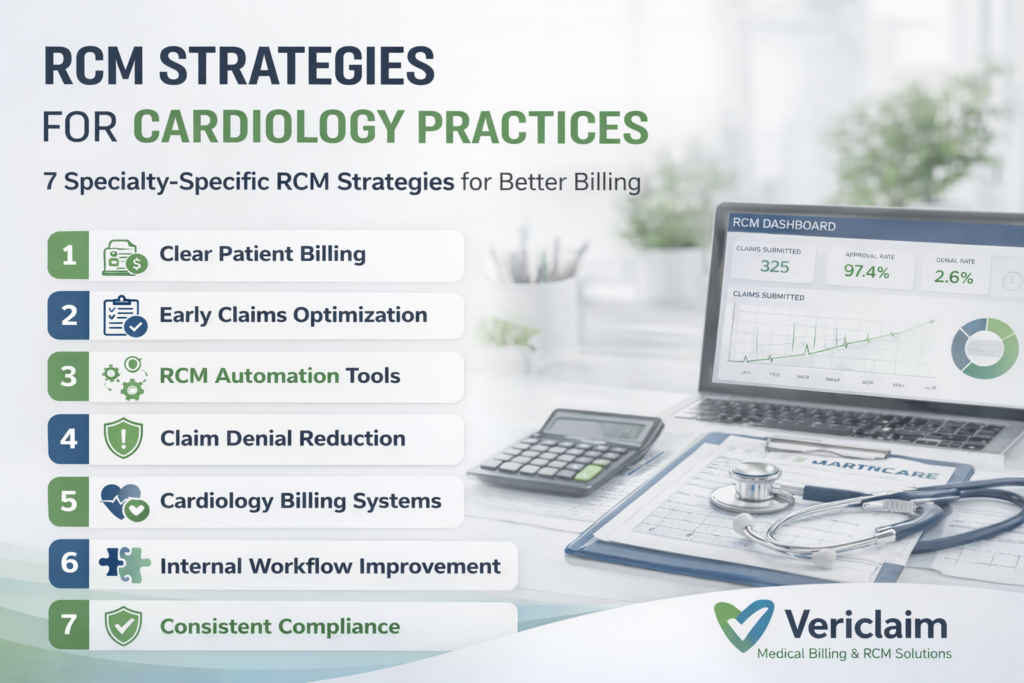
Running a cardiology practice comes with its own pace. Some days feel smooth, while others get tangled in billing delays, claim issues, and follow-ups that never seem to end. That’s exactly where RCM strategies for cardiology practices start to make a visible difference. When handled the right way, they don’t just fix billing problems; they quietly improve how the entire practice functions.
Start With Clear Patient Billing
One thing many practices underestimate is how much confusion a simple bill can create. When patients don’t fully understand their charges, payments slow down. It’s as simple as that.
Focusing on patient billing accuracy helps remove that friction. Clean statements, clear wording, and fewer surprises build trust. And once that trust builds, payments follow more naturally. Over time, this alone can support steady practice revenue growth without adding extra pressure on staff.
Clean Up the Claims Process Early
Insurance claims often become a problem only after they are submitted. That’s where most practices lose time. Instead of fixing issues later, it works better to tighten the process up front. Verifying eligibility, double-checking codes, and aligning documentation properly all contribute to stronger insurance claim optimization.
From what we’ve seen in real cardiology setups, even small corrections here reduce back-and-forth communication significantly.
Automate the Repetition
Employees don’t have to spend hours repeating the same duties. This is where RCM automation tools quietly change the game. They take over repetitive work like claim submissions, reminders, and payment posting. The result? Fewer manual mistakes and a much lighter workload.
You’ll notice something interesting here. When staff are not buried in regular work, their focus moves naturally toward patient interaction, and that enhances the general environment inside the office.
Pay Attention to Why Claims Get Denied
Denied claims are frustrating, but they are also informative. They tell you exactly where things are going wrong. Using claim denial reduction strategies means looking at patterns instead of reacting randomly. Maybe it’s a coding issue. Maybe it’s missing documentation. Once you spot the pattern, fixing it becomes easier.
And, most practices find that a few repeated mistakes are responsible for the majority of denials.
Use Billing Systems That Understand Cardiology
Not every billing system fits cardiology’s needs. Heart-related procedures come with their own coding complexity, and generic systems often miss those details.
That’s why many practices move toward cardiology billing solutions that are built with these specifics in mind. These systems naturally increase practice efficiency in cardiology, lessen confusion, and better match actual processes. The key is to use the appropriate instrument, not to add more.

Fix Internal Workflow Gaps
Sometimes the issue isn’t billing software or insurance. It’s internal flow. Everything can be slowed down by small gaps in the documentation, delays in updating records, or confusing duties. In cardiology, increasing practice efficiency frequently begins with small team improvements. You might notice that once internal coordination improves, everything else, including claims and payments, starts moving faster too.
Stay Consistent With Compliance
Regulations are subject to change, and ignoring these changes could have significant implications. Keeping up medical billing compliance doesn’t have to be difficult. You can usually stay on track with regular training, brief reviews, and knowledge of coding changes. It’s one of those areas where consistency matters more than intensity.
Build a Stronger System With Vericlaim
When all these pieces come together, the difference becomes clear. Billing feels less reactive and more controlled. Errors reduce. Payments speed up.
That’s exactly what effective RCM strategies for cardiology practices are meant to do. With Vericlaim, practices gain structured RCM support designed specifically for cardiology workflows, improving claim accuracy and collections. Choosing the right approach today can make daily operations feel lighter tomorrow.
FAQs: RCM Strategies for Cardiology Practices
1. What are RCM strategies for cardiology practices?
They are focused methods that improve billing flow, reduce errors, and support steady practice revenue growth.
2. How do revenue cycle management tips help?
They guide practices to verify insurance early, correct coding mistakes, and improve patient billing accuracy.
3. Can cardiology billing solutions reduce denials?
Yes, they align better with procedures and help improve insurance claim optimization.
4. Why does workflow efficiency matter so much?
Better internal flow reduces delays and improves practice efficiency in cardiology, which directly impacts revenue.
5. Are RCM automation tools really helpful?
They reduce manual work, lower errors, and free staff to focus on patients.
6. What are effective ways to reduce claim denials?
Tracking patterns and fixing repeated mistakes using claim denial reduction strategies works best.
7. How does Vericlaim support practices?
Vericlaim provides tailored solutions, expert guidance, and systems that simplify billing and improve performance.