

Running a healthcare practice is a constant balancing act, and the paperwork usually feels like the biggest hurdle. We see so many dedicated providers focus entirely on patient care, only to get blindsided by administrative complexities they didn’t see coming. Truth be told, your revenue hinges on how you categorize your medical claims. Whether you are a solo practitioner or part of a massive facility, getting the claim type right is the difference between getting paid and getting a denial. At Vericlaim Partners, we prioritize this distinction to keep your cash flow moving without those unnecessary, preventable delays.
What Are the Different Types of Medical Claims?
In the billing world, everything depends on who is providing the service and where it’s happening. Generally, we split these into two main categories: professional and institutional. It might sound like a minor detail, but the forms and rules behind them are completely different. Professional billing focuses on the person providing the care, while institutional billing covers the facility itself. We use this distinction to guide our workflows, ensuring every service is mapped to the correct form. Sending a service on the wrong form is basically an invitation for a payer to reject it.
How Professional Claims Work
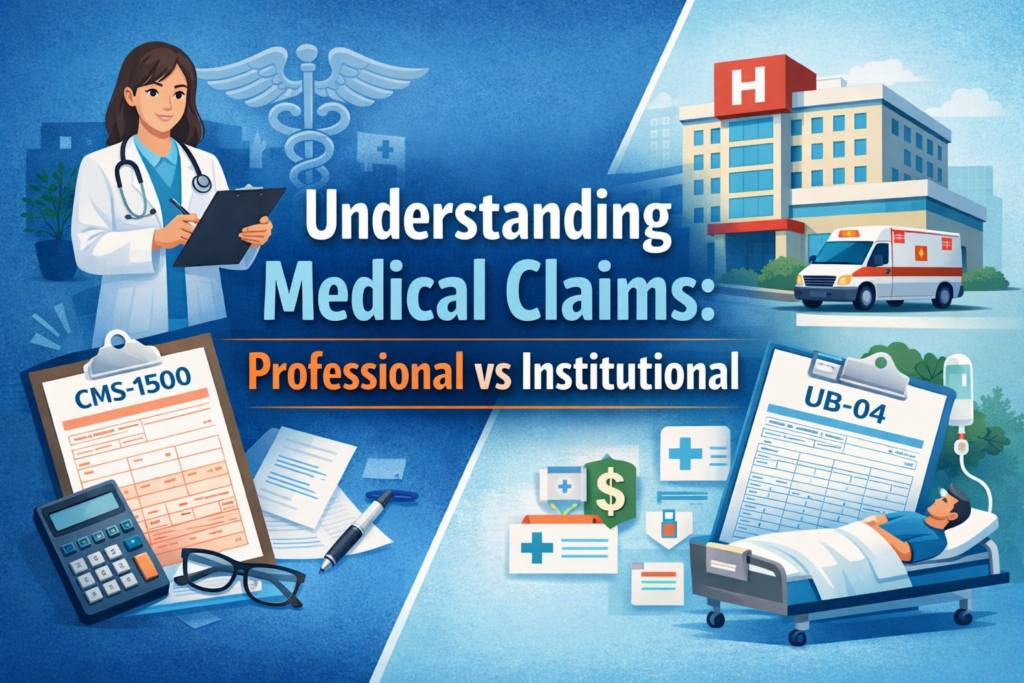
Professional claims are all about the direct work done by providers think doctors, PAs, or specialized therapists. These are billed on the CMS-1500 form, which is the standard red-ink document used for outpatient services. And here’s the thing: these medical claims follow the provider regardless of the setting, meaning a surgeon might bill a professional fee even for a hospital procedure. We keep a close eye on these because they require specific modifiers to explain the exact nature of the visit. Getting these right ensures your independent practice stays financially stable.
Who Typically Submits Professional Claims?
You’ll usually see these coming from independent physicians, private group practices, or outpatient clinics. If you own your own building and see patients for routine checkups, you’re dealing with professional billing. Even if you’re a specialist doing a consultation at a local nursing home, your personal fee goes out as a professional claim. We support these smaller, more agile practices by handling the heavy administrative lifting. Our goal is to make sure you get paid for your time without the headache of manual data entry.
How Institutional Claims Work
Institutional claims are significantly more complex, as they cover the overhead, the room, and the equipment of a facility. These go out on the UB-04 form, which is designed to bundle high-intensity services like inpatient stays or emergency room visits. Because these medical claims involve much higher dollar amounts, insurance companies are highly detail-oriented about how they are formatted. Vericlaim Partners works to review and validate these facility bills, checking for errors that could initiate a lengthy audit. It’s all about protecting the facility’s bottom line from technical mistakes.
Who Typically Submits Institutional Claims?
Hospitals, skilled nursing facilities, and home health agencies are the main players here. Unlike a solo doctor’s office, these institutions have to bill for the entire environment—the nursing staff, the bed, the pharmacy, and the equipment. It’s a collective bill for the facility’s resources rather than one person’s expertise. We help these organizations navigate the complex revenue codes required for this level of reporting. Managing institutional medical claims effectively is what keeps large-scale healthcare systems running smoothly.
Key Differences Between Professional and Institutional Claims
The real difference is the focus: the practitioner versus the brick-and-mortar building. While a professional claim might list a specific evaluation code, the institutional claim for that same visit will focus on the facility fee and supplies. Payer rules are also a moving target; Medicare Part B handles the professional side, while Part A covers the institution. We stay on top of these nuances so you don’t have to guess which form to use. Understanding these medical claims dynamics is the only way to avoid leaving money on the table.
How Claim Types Affect Billing Practices
Where you stand when you provide care changes how you have to bill. An office visit has a much simpler path to payment than a three-day stay in a cardiac wing. We’ve noticed that when location codes don’t match the form type, the rejection rate spikes immediately. It’s not just a clerical task; it’s a strategic requirement for staying compliant with payer rules. We help our partners refine these internal processes to match their specific setting.
Preventing Common Billing Errors
Truth be told, even a small typo in a provider’s NPI number can freeze your revenue for weeks. Common mistakes often involve using the wrong form for an outpatient procedure or missing a location-specific modifier. We recommend a proactive scrubbing process to catch these errors before the payer ever sees them. By focusing on the precision of your medical claims, you save your staff from hours of tedious appeal work. High accuracy is simply the best way to keep your practice’s cash flow predictable.
Best Practices for Matching Claims to Services
Consistency is the secret to a high-performing billing department. You have to make sure your clinical notes actually back up the codes you’re putting on those medical claims. If a doctor’s documentation is thin, the insurance company will likely recover the payment during an audit. We work with our clients to ensure their documentation is thoroughly supported and fully supports the billed amount. This tight connection between the exam room and the billing office is what builds a successful practice.
Choosing a Reliable Medical Billing Partner
At the end of the day, managing these two different billing worlds is a complex operational demand for any medical team. Partnering with Vericlaim Partners means you don’t have to be a master of both CMS-1500 and UB-04 standards. We specialize in the end-to-end management of medical claims, handling everything from the first authorization to the final payment. Our expertise in medical billing ensures you stay compliant while maximizing the revenue you’ve rightfully earned. Let us handle the technical side of your medical claims so you can focus on the patient care that matters most.