
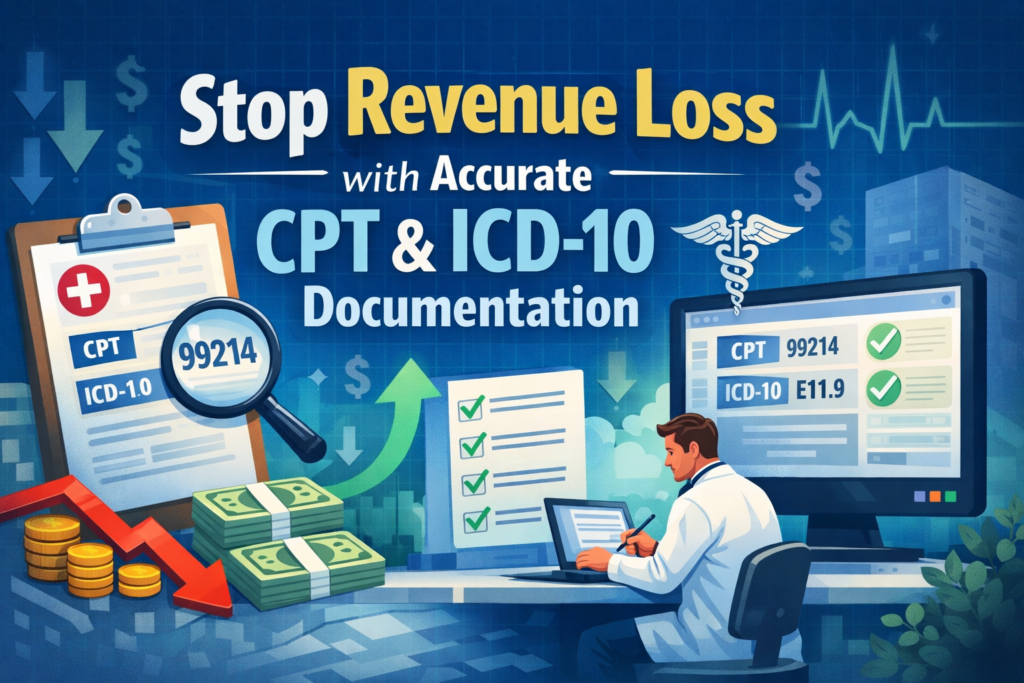
Running a medical practice is demanding. Between patient care and staff management, the financial side often becomes a secondary thought until the bank balance drops. Most revenue leaks stem from a simple breakdown in your CPT & ICD-10 documentation. At Vericlaim Partners, we don’t just process papers; we identify and address areas where revenue may be lost. Precise notes aren’t just for compliance; they are your actual paycheck. When you master CPT & ICD-10 documentation, your revenue finally starts to match your clinical effort.
What Is Medical Billing and Coding?
Think of this as a high-stakes translation job. You’re taking a complex, messy human interaction and turning it into a string of digits for a computer to read. Accurate medical coding ensures the insurance company actually understands what you did in that exam room. We act as that bridge, making sure the language of your claim is perfect. Without this translation, your office is essentially free of cost. It’s the single most important link in your practice’s financial chain.
How Does CPT & ICD-10 Documentation Improve Revenue?
There is a direct link between your clinical notes and your bank account. Good CPT & ICD-10 documentation proves that the service you provided matches the price you’re asking for. We see it all the time: doctors who do great work but write thin notes. That’s just leaving money on the table for the insurance companies to keep. By beefing up your internal standards, you force payers to release your money on time, every time.
Why Is Precise Code Application Vital?
Using the right code isn’t just a suggestion; it’s an operational necessity. Each code has a definition that has to mirror your patient records perfectly. If they don’t align, the payer flags it as a mistake or worse, fraud. We help you navigate these messy code selections so every claim is bulletproof before it leaves the desk. This kind of precision keeps you safe from audits while speeding up your cash flow.
Who Can Use These Coding Standards?
Basically, if you bill insurance, these rules apply to you. It doesn’t matter if you’re a specialist or a local GP; the documentation requirements are equally strict. We work with a huge range of clinicians to fix these administrative headaches. The goal is simple: make sure everyone in your building knows how to support a clean claim. When the whole team is on the same page, the billing friction just disappears.
What Are the Requirements for Clean Claims?
A clean claim goes through the system without a human ever touching it. For that to happen, your CPT & ICD-10 documentation must prove medical necessity beyond any doubt. We’re talking about clear signatures, solid diagnostic info, and a logical timeline. Payers actively review claims for even minor discrepancies. When records are incomplete or poorly structured, you’re effectively giving them a reason to delay or deny payment.
Which Common Coding Errors Should You Avoid?
The biggest trap is using generic, templated documentation that looks the same for every single patient. That is frequently flagged during audits. Other killers include using close enough ICD-10 codes because they’re easier to find. We focus on scrubbing those claims to catch the slips before the payer does. Fixing a mistake in the office is free; fixing it after a denial costs you hours of administrative time.
When Do Coding Errors Lead to Denials?
A denial is more than just a delay; it’s a significant strain on your staff’s energy. Most of these rejections happen because the diagnosis doesn’t justify the procedure. When your CPT & ICD-10 documentation is vague, the insurance company’s computer just hits the reject button. We track those patterns to help you fix the root cause in the exam room. This stops the endless loop of resubmitting the same claims over and over.
What Are the Best Payer Billing Considerations?
Medicare and private payers don’t play by the same rules. It’s a constant headache trying to remember who needs prior authorization and who doesn’t. We keep track of those moving goalposts so your clinical team doesn’t have to. Sometimes a commercial payer will contradict Medicare’s basic policy. Knowing that difference before you submit is the secret to a high-performing revenue cycle.
Why Is Proper Modifier Usage Critical?
Modifiers add the context that raw code can’t provide. They tell the payer if you did two separate procedures or worked on both ears, for example. Incomplete CPT & ICD-10 documentation often leaves the modifier high and dry, leading to an instant rejection. We make sure your notes explain the why behind every modifier. This gives the payer zero excuses to stall your reimbursement.
How to Bill Multiple Services Accurately?
Billing for three or four things in one visit is a documentation minefield. You have to prove each one was a separate, necessary service to avoid bundling traps. We help you organize those notes so every line on the claim stands on its own. This prevents payers from combining your services into a single, low-paying code. It’s about getting every dollar you earn.
Why Partner With VeriClaim Partners for Your Growth?
At the end of the day, your focus should be on your patients, not on insurance portals. Managing CPT & ICD-10 documentation is a full-time job that requires professional eyes. Vericlaim Partners steps in as your growth partner, handling the technical grind so you can scale your practice. We maximize your collections while reducing the administrative strain that keeps you up at night. Let us handle the codes so you can handle the care.